Pharmacy SMS in Guinea: prescriptions, new arrivals, on-call duty
Pharmacy SMS in Guinea: Notify Your Patients at the Right Time
A patient stops by your counter in the morning; the product isn’t in stock, so you write down their number on a scrap of cardboard. Three days later, the cardboard is gone, the medication has arrived, and the patient has gone to buy it elsewhere. The Pharmacy SMS It’s designed precisely to prevent this kind of situation: a short message, signed with your clinic’s name, sent at the exact moment when the information matters most to the patient.
This article explains, for a pharmacy in Conakry, Kindia, or Labé, what messages to send, when to send them, how much they actually cost, and what you’re losing each week by not sending them.
In pictures
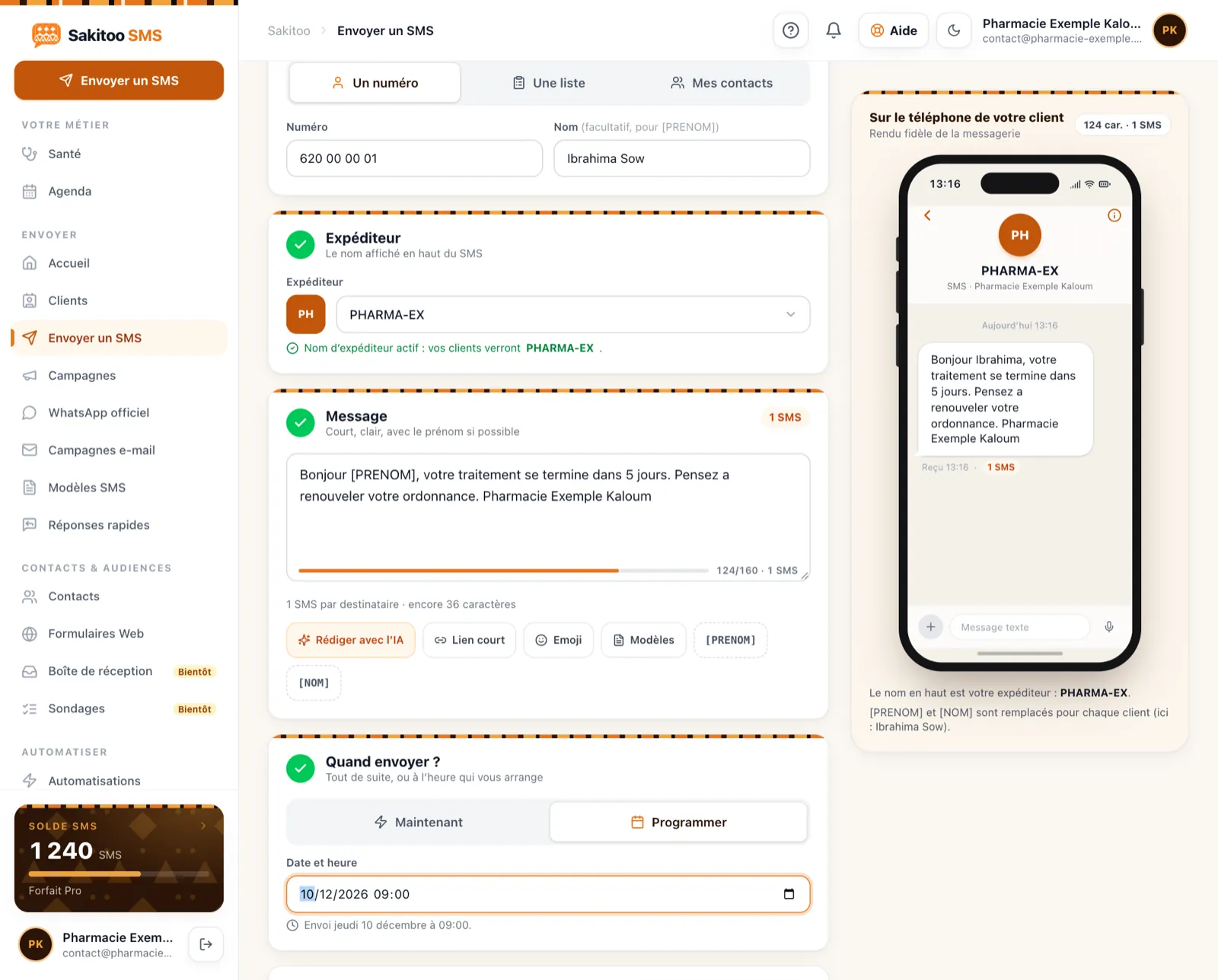
Table of Contents
- What You're Missing Without SMS
- Five Useful Messages from a Pharmacy
- Confidentiality: Writing about health without exposing the patient
- Organize your patient database
- Set up your SMS campaigns in just one morning
- How much does it cost?
- Common Mistakes
- Frequently Asked Questions
What You're Missing Without SMS
The role of a pharmacist in Guinea is built on trust and personal connection. But there’s a limit to that personal connection: you can’t call every patient one by one.
Sales going to the neighbor
When a product is out of stock, patients rarely wait. If they don’t know their order has arrived, they’ll go to the pharmacy next door—and they may end up staying there. The cost isn’t just the unsold package; it’s the regular customer who changes their habits.
Calls that tie up the counter
Calling a patient takes time: the phone rings, they don’t answer, you call back, you leave a voicemail. Meanwhile, the line of patients keeps growing. A text message is sent in just a few seconds, and the patient reads it when they can.
Long-running processes that have been interrupted
High blood pressure, diabetes, asthma: many patients forget to return before their medication runs out. Interrupting treatment is not good for them or for their relationship with your pharmacy. A reminder a few days before the end of their treatment is a service, not advertising.
The Guards Nobody Knows
On night shifts, people in the neighborhood don’t always know you’re open. Families tend to wander in at random. Sending a message the night before to patients who have agreed to receive it helps everyone.
Five Useful Messages from a Pharmacy
A pharmacy doesn’t need to send a lot of messages. It needs to send the right ones. Here are the five that really come in handy.
1. “Your order is ready”
It’s the simplest message—and often the one people are most looking forward to.
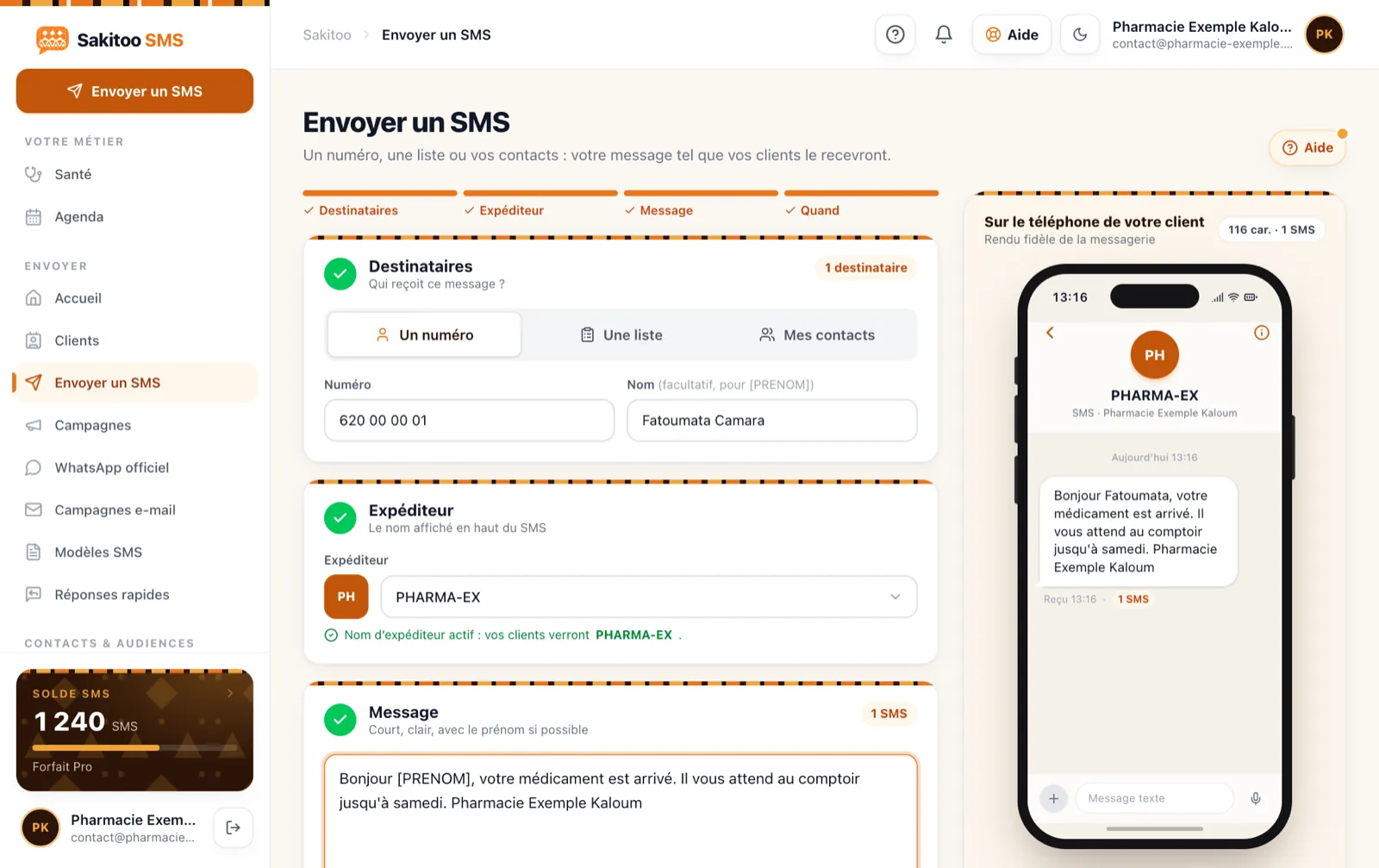
Example: “Hello, Mr. Camara, your order No. 214 is ready at the Pharmacie du Port (Kaloum). It will be held for you until Saturday.”
You can send this text message from your computer or the Android app by selecting the contact. No product name is required, and the reservation period is clearly stated.
2. Renewal reminder for prescriptions
For a patient on long-term treatment, you schedule the reminder a few days before the supply is expected to run out.
Example: “Hello, Ms. Diallo, your prescription is about to expire. Please remember to stop by with your prescription. Madina Centre Pharmacy.”
On the day you treat a patient, you can already schedule the next follow-up message. You don’t have to think about it anymore—the message is sent automatically on the scheduled date. See how to do it in Our guide to scheduling an SMS.
3. The on-call notice
Example: “Hamdallaye Pharmacy is open this Sunday, day and night. In case of an emergency, you’re welcome to visit.”
Send it only to patients who have agreed to receive updates, and in the morning rather than late at night.
4. The arrival of a product that several people have been waiting for
When there’s a shortage of a commonly used product, several patients are waiting for it. You’ve grouped them under a single label (“waiting for product X”) and are sending them a single email, without mentioning the product by name if it’s a sensitive treatment.
5. Practical Information
Changes to business hours during Ramadan, special closures, a new phone number, or a pharmacy relocation—these are the kinds of updates your patients want to know about. One text message is all it takes.
What a pharmacy should not send
Avoid aggressive promotion of medications, daily messages, and any references to specific illnesses. A pharmacy is a place of trust; your text messages should be too. Over-the-counter products (cosmetics, baby care items) may be advertised occasionally, provided the patient has agreed to receive this type of information.
Confidentiality: Writing about health without exposing the patient
A phone is passed around: a child plays with it, a spouse reads the notifications. Your text messages should be readable by anyone without disturbing the patient.
Three simple rules
- Never mention the name of a disease, never include the names of sensitive medications (contraceptives, psychiatric treatments, HIV medications, etc.).
- An unbiased resource : order number, first name, “your order,” “your order status.”
- A clear sender name : The patient must know immediately that the message is coming from their pharmacy and not from a stranger.
Sender's name
An SMS that displays “PHARMAPORT” instead of an unknown number is trusted by recipients. It also helps protect against scams: patients learn to recognize your name. The sender name is free with the Pro plan (1,000 SMS). Everything is explained in Our article on the sender's name.
Consent
Ask at the counter: “Would you like us to notify you via text message when your order arrives?” One sentence is all it takes. If a patient tells you they no longer want to receive messages, simply remove them from your mailing list. Sakitoo SMS lets you mark a contact as unsubscribed: they will no longer receive your messages.
Organize your patient database
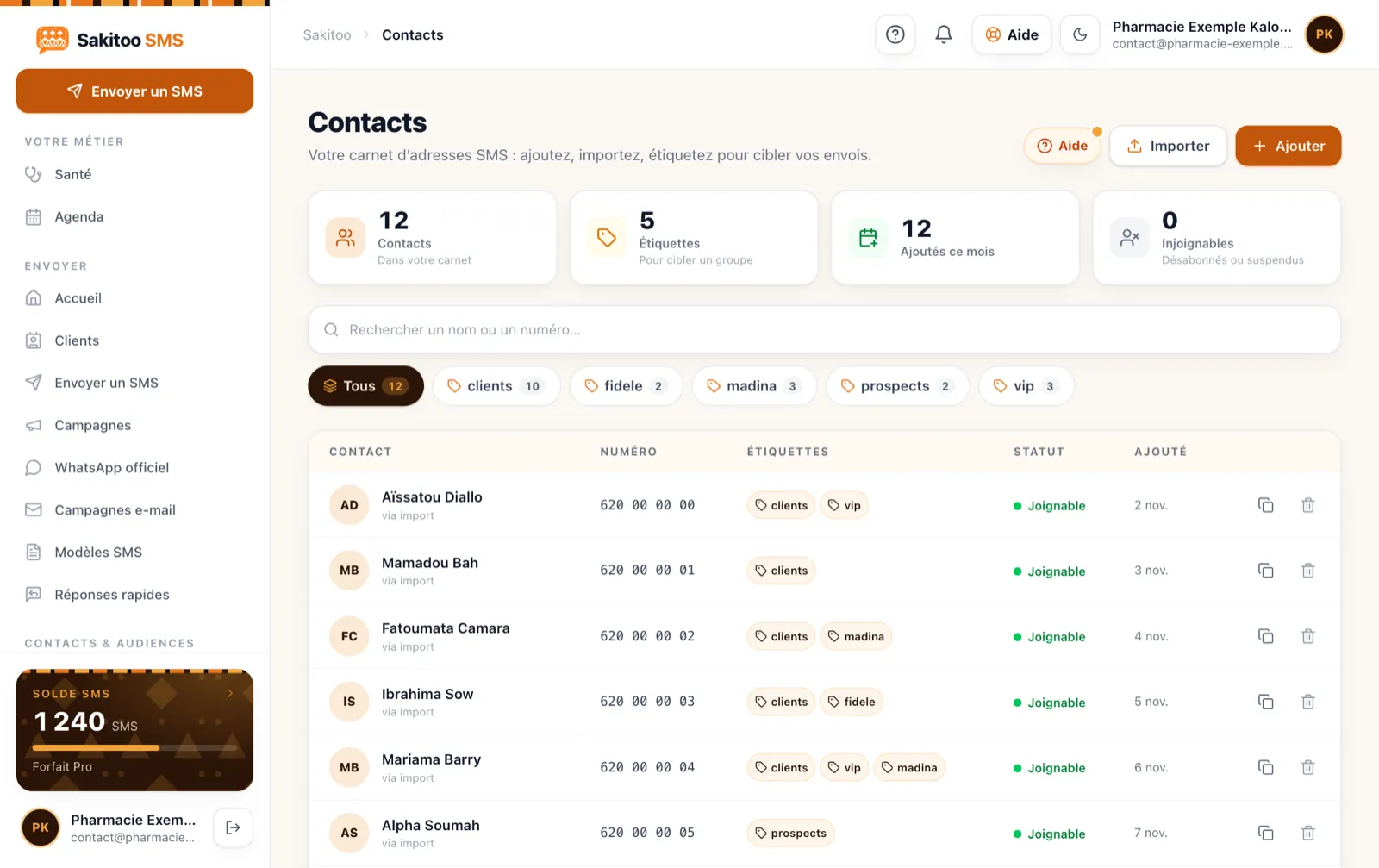
The database is the heart of the system. A pharmacy with 300 neatly organized phone numbers sends more accurate messages than one with 3,000 numbers in a jumble.
Useful tags
| Tag | Who is it for? | Sample message |
|---|---|---|
| Order pending | Patients waiting for a product | "Your order is ready" |
| Long processing time | Patients undergoing long-term treatment | Renewal Reminder |
| On Call | Patients agree to be notified of on-call schedules | On-call notice |
| Health and Beauty Store | Customers interested in non-pharmaceutical shipments | Occasional advertisement |
| Businesses / Organizations | Customer accounts (businesses, schools, NGOs) | Billing Information |
A single patient can have multiple tags. Messages are then sent to a specific tag, not to everyone.
Import what you already have
You may have a notebook, an Excel file, or the contacts from the pharmacy’s phone. The Sakitoo SMS import feature accepts a file, a pasted list, or the phone’s contact list. It identifies the columns (name, number), and the data cleanup process formats Guinean numbers correctly, removes duplicates, and flags incomplete numbers. You won’t be charged for text messages sent to numbers that don’t exist.
Add new patients as they come in
The easiest way: when entering the order, add the contact directly from the Android app, using the correct label. If you prefer, a web form A QR code displayed at the counter allows patients to register themselves.
Set up your SMS campaigns in just one morning
Here is a realistic scenario for a pharmacy just starting out.
Step 1: Create an account
Sign up online at the sign-up page, number verification via SMS. The account is ready in just a few minutes. General instructions are detailed on the page How it works.
Step 2: Request the sender's name
Choose a short name (11 characters maximum, no spaces) that resembles your business name: “PHARMAPORT,” “PHCIEMADINA.” Validation takes a little while; in the meantime, you can already start sending messages.
Step 3: Import and label
Start small: patients on long-term treatment and this week’s pending orders. The rest will follow.
Step 4: Prepare your templates
Save three or four message templates (order ready, renewal, admission, schedule). The patient’s first name is filled in automatically. When the day arrives, you select the template and the contact—just two clicks.
Step 5: Schedule reminders
For each patient undergoing long-term treatment, schedule the next follow-up appointment. The automations They also allow you to schedule a message to be sent on a date associated with the contact.
Step 6: Track deliveries
In the reports, you can see which messages were delivered. If a number fails multiple times, check it with the patient during their next visit.
Use cases: three pharmacies, three needs
These scenarios are examples for illustrative purposes only; they are not actual clients.
Example: a neighborhood pharmacy in Matoto
It is mainly used by families. Its primary purpose is to notify them when an order arrives. It sends a few dozen text messages per week. A Starter Pack (200 text messages) lasts several weeks.
Example: a large pharmacy in Kaloum
She has many patients undergoing long-term treatment, business accounts, and regular on-call shifts. She uses scheduled reminders and on-call notifications. The Pro package (1,000 SMS) includes a custom sender name at no extra charge.
Example: a pharmacy in Kindia
Patients sometimes come from distant villages. A message saying “Your order has arrived” saves them a wasted trip. Here, every text message saves the patient time and the cost of transportation.
How much does it cost?
The prices below are those listed on The Pricing Page, verified on 11/13/2026. Check the website before placing an order, as prices are subject to change.
SMS packages
| Package | SMS | Prices | Price per SMS |
|---|---|---|---|
| Explore | 50 | 12,500 GNF | 250 GNF |
| Starter | 200 | 42,000 GNF | 210 GNF |
| Pro | 1 000 | 205,000 GNF | 205 GNF |
| Business | 5 000 | 1,025,000 GNF | 205 GNF |
| Business | 20 000 | based on a quote | based on a quote |
Purchased text messages never expire. You won’t lose anything if you send fewer than the monthly limit.
Good to know
- A long message (more than 160 characters, or fewer if you use special characters) counts as multiple SMS messages. The number is displayed before sending, so you always know what you’ll be charged.
- The sender's name is free with the Pro plan (1,000 SMS).
- For a pharmacy that also manages appointments (consultations, tests), the plan Health + Calendar For 170,000 GNF per month, you get 300 SMS messages, appointment reminders sent the day before, and prescription renewal notifications. With annual payment, you pay for 10 months but get 12.
Get a quote for your pharmacy
Count the number of orders pending for a week and your patients on long-term treatment. If you notify 40 patients per week, that’s about 170 text messages per month. Compare that to the value of a single lost sale because the patient wasn’t notified. To learn more, read Details on the price of an SMS in Guinea.
Common Mistakes
Send to the entire list
A patient who receives an on-call notification without having requested it will eventually unsubscribe. Send to the relevant label.
Forget the time
An SMS at 10 p.m. about a delivery can be disruptive. Schedule your messages during the day, avoiding prayer times.
Text is too long
A clear text message fits into one or two lines. If it’s longer, you’ll be charged for multiple text messages, and the message will be harder to read.
Reservation not held
If the text message says “hold until Saturday,” stick to it. Trust is built one message at a time.
Learn more
- Partner clinics and laboratories can automate reminders: see SMS appointment reminders.
- Pharmacies that also sell over-the-counter health products can build customer loyalty: see SMS loyalty programs for retail stores.
- The Health page features the dedicated business tool.
Frequently Asked Questions
Detailed answers can be found at the top of the page (FAQ). In summary: only text patients who have given their consent, be discreet, sign off with your pharmacy’s name, and set up reminders so you don’t have to worry about it.
Conclusion: A service counter that continues to operate even after closing time
A well-written text message extends the service provided at the counter. Patients know their order is ready, they don’t forget to take their medication, and they’re aware of your on-call hours. You save time on the phone and retain your customers. Start with a Discovery Pack, test the “Your order is ready” message for a week, then decide.
Create an account for your pharmacy Send your first text message today to any network in Guinea: Orange, MTN, and Cellcom.
Frequently Asked Questions
Is a pharmacy allowed to send text messages to its patients?
Yes, provided that you only text people who have given you their number so they can be notified, that you remain discreet about health matters, and that you remove anyone who no longer wants to receive messages.
Should the name of the medication be included in the text message?
We do not recommend this. Someone close to you might see the text message. Instead, write “Your order is ready” along with an order number or the customer’s first name.
My patients have different SIM cards—will they all receive the message?
Yes. Sakitoo SMS sends messages to all networks in Guinea: Orange, MTN, and Cellcom. You don’t have to sort your contacts by carrier.
How much does an SMS cost for a pharmacy?
Packages start at 12,500 GNF for 50 SMS messages and go as low as 205 GNF per SMS with the Pro package of 1,000 SMS messages. Purchased SMS messages never expire. Prices verified on 11/13/2026.
Can I schedule renewal reminders in advance?
Yes. You choose the date and time to send the message when you compose it, and the message is sent automatically, even if the pharmacy is closed.